

Why Prompt Engineering Is Becoming Less Important Than System Design
If you knew the right wording, the right structure, or the right tricks, you could squeeze surprisingly good results out of early AI models. People shared prompts like recipes. Courses promised that better prompts were the key to better AI.



Why Prompt Engineering Is Becoming Less Important Than System Design
For a while, prompt engineering felt like a superpower.
If you knew the right wording, the right structure, or the right tricks, you could squeeze surprisingly good results out of early AI models. People shared prompts like recipes. Courses promised that better prompts were the key to better AI.
That phase is ending.
Prompt engineering still matters, but it is no longer the thing that separates good AI from bad AI. System design does.
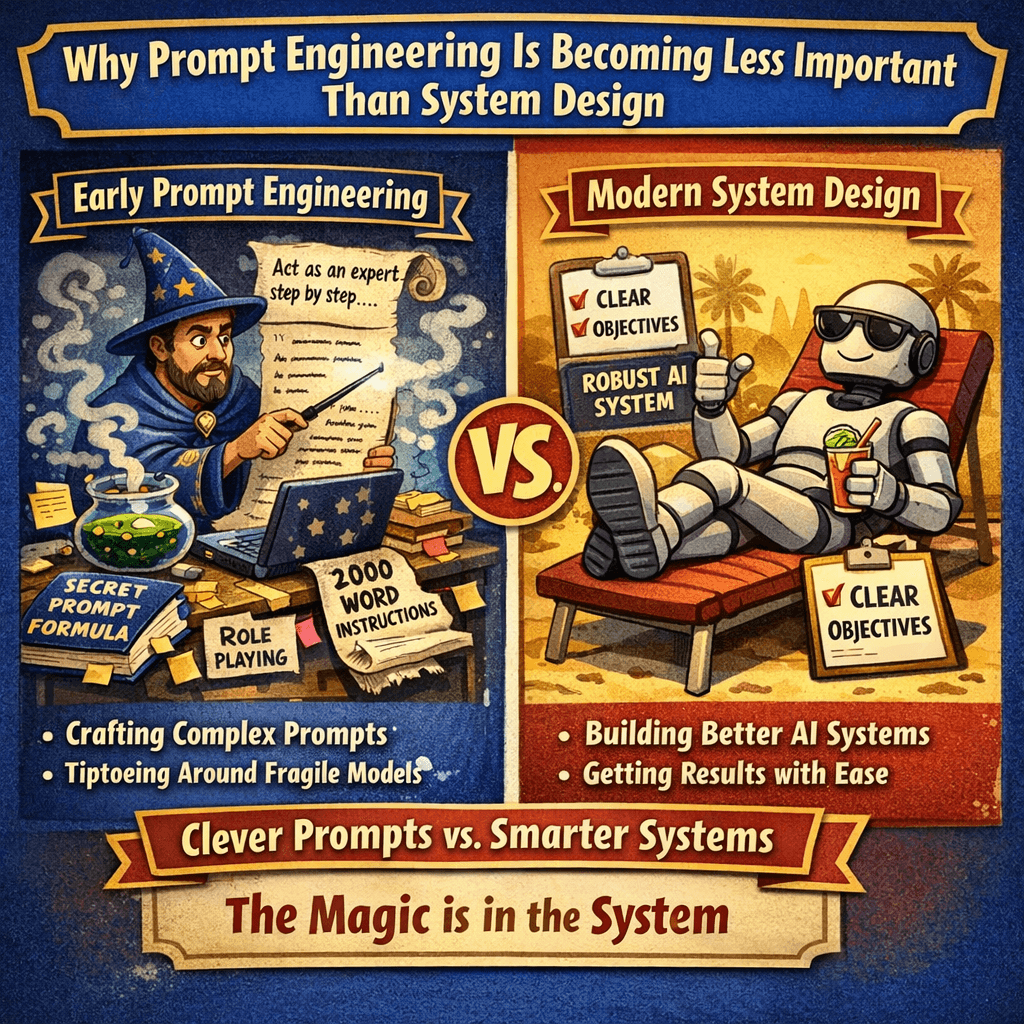
Prompt engineering worked because models were fragile
Early language models were easy to confuse. Small wording changes produced wildly different outputs. If you did not spell everything out, the model would often miss the point.
So people learned to over explain. They added role playing. They forced step by step reasoning. They wrapped simple requests in long instructions.
At the time, this made sense. The prompt was doing work the system could not.
But modern models behave differently.
Models now understand intent much better
Newer models are far more tolerant of imperfect input. They handle ambiguity better. They infer goals without needing rigid structure. They follow instructions even when they are not written like a legal contract.
This reduces the value of prompt cleverness.
A clear request usually works. A slightly messy one often works too. Spending hours polishing wording delivers smaller and smaller gains.
The ceiling is no longer set by the prompt.
Most real problems are not prompt problems
When AI fails in production, it is rarely because someone used the wrong phrasing.
It fails because:
The model lacks the right context
The input data is incomplete or outdated
There is no memory of previous interactions
Outputs are not checked or constrained
Errors are not handled
The system does not know when to ask for help
No prompt fixes that.
You can write the perfect instruction and still get poor results if the surrounding system is weak.
Systems decide what the model can do
A prompt is just one input.
A system decides:
What information the model sees
What tools it can use
When it is allowed to act
How outputs are validated
What happens when something goes wrong
Once these decisions are made well, the exact wording of the prompt matters far less.
This is why two teams using the same model can get very different results. One built a solid system. The other relied on prompts alone.
Prompt tricks do not scale
Prompt based solutions tend to be brittle.
They depend on:
Specific phrasing
Hidden assumptions
Model quirks that change over time
As soon as the model updates or the use case grows, things break.
System design scales because behavior is enforced by structure, not wording. Logic lives outside the prompt. Changes can be tested. Models can be swapped without rewriting everything.
This matters if you are building something meant to last.
Tool use changed the game
Modern AI does more than generate text.
It searches.
It calls APIs.
It queries databases.
It performs multi step tasks.
It interacts with users over time.
In these setups, the prompt is just one small piece of a larger flow. What matters more is how tasks are broken down, how information moves through the system, and how decisions are checked.
You do not prompt your way into reliability. You design it.
Prompt engineering is becoming basic literacy
This does not mean prompt engineering is useless.
It means it is becoming expected.
Knowing how to write a clear instruction is now like knowing how to write a readable function. Necessary, but not impressive on its own.
The real leverage comes from understanding systems, not sentences.
Where this is heading
The people building the strongest AI products are not obsessed with prompt tricks. They think about architecture, data, failure modes, and user behavior.
Prompt engineering opened the door. System design is what makes AI useful once you step inside.