

The Rise of AI Orchestration Tools
Prompts live in one place. Data pipelines live in another. Tools break quietly. Outputs are inconsistent. Teams patch problems with scripts, spreadsheets, and manual checks. That approach works until it doesn’t.

AI systems rarely fail because the model is weak. They fail because everything around the model is messy.
Prompts live in one place. Data pipelines live in another. Tools break quietly. Outputs are inconsistent. Teams patch problems with scripts, spreadsheets, and manual checks. That approach works until it doesn’t. As AI use moves from experiments into daily operations, coordination becomes the hard part. That is where AI orchestration tools come in.
What AI orchestration actually means
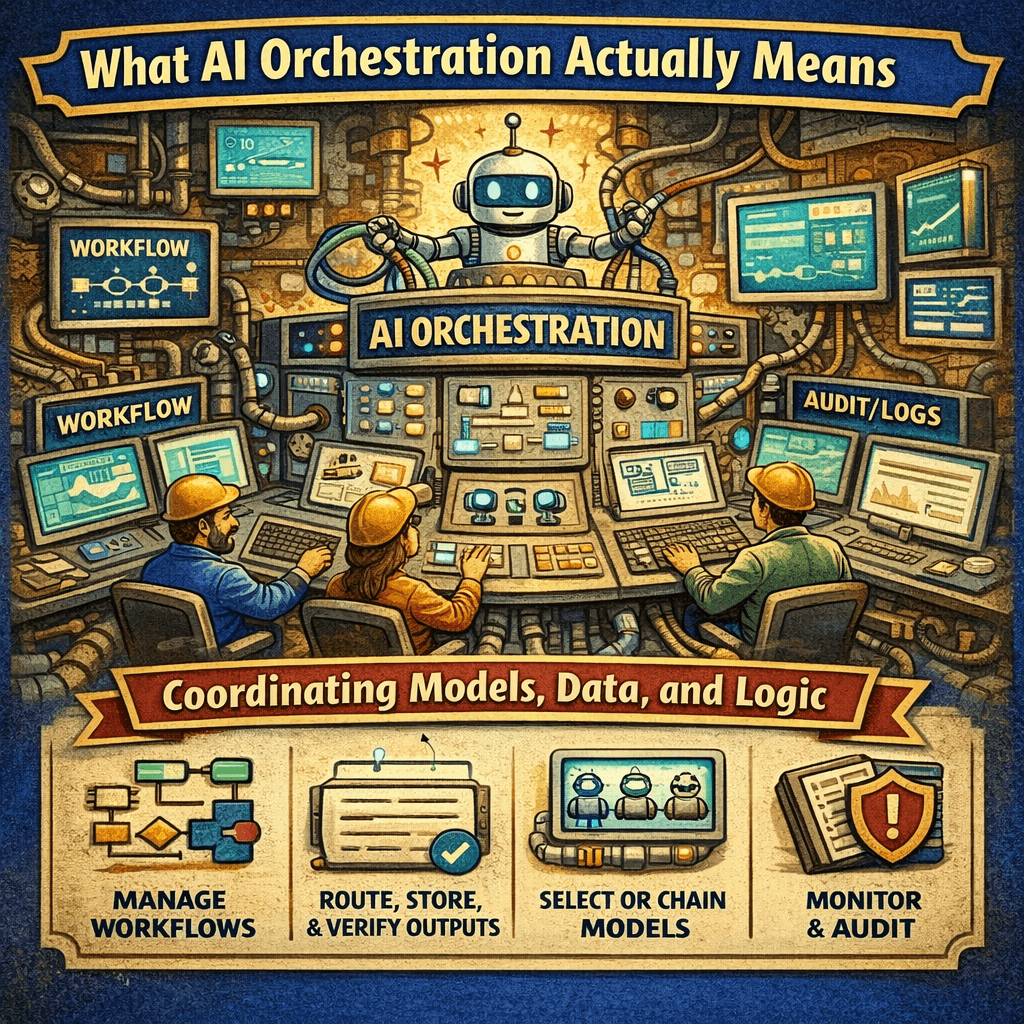
AI orchestration tools sit above individual models. They manage how models, data sources, APIs, and business logic work together. Instead of a single prompt going to a single model, you have workflows. Inputs are validated. Models are selected or chained. Outputs are routed, stored, checked, or fed into the next step.
This is not theoretical. A typical setup might involve one model classifying intent, another generating text, a third verifying outputs against rules, and a logging layer capturing everything for audit or improvement. Orchestration is what makes that manageable.
Without orchestration, teams rely on brittle glue code. With it, they get visibility and control.
Why this is happening now
Early AI deployments were narrow. One model, one task. Today, companies are running dozens of AI-driven processes across customer support, operations, marketing, analytics, and internal tooling. Each use case brings its own data sources, constraints, and risks.
At the same time, model choice is no longer static. Teams switch between providers for cost, latency, or capability reasons. Some workloads move to open source models. Others require fallback logic when APIs fail or rate limits hit.
AI orchestration tools exist because manual coordination does not scale. They provide a way to manage complexity without rebuilding systems every time something changes.
What problems orchestration tools actually solve
The main value is not automation. It is reliability.
Orchestration platforms help with versioning prompts and workflows so changes are traceable. They handle retries, fallbacks, and error states. They centralise logging, which matters when outputs affect customers or decisions. They make it possible to test changes before rolling them out.
They also force clarity. When you define a workflow explicitly, assumptions surface. Where does data come from. What happens if confidence is low. Which outputs are allowed through. These questions are often ignored until something goes wrong.
For regulated industries, orchestration is often the difference between using AI at all and not being able to justify it.
Trade offs to be aware of
Orchestration tools add another layer. That layer has a learning curve and a cost. Poorly chosen platforms can lock teams into rigid abstractions that slow iteration. Over engineered workflows can become harder to maintain than simple scripts.
There is also a temptation to treat orchestration as a silver bullet. It is not. Bad prompts, weak evaluation, or unclear objectives do not disappear just because they are wrapped in a workflow tool.
Teams need to be honest about scale. If AI usage is small and unlikely to grow, orchestration may be unnecessary overhead. If AI is becoming core infrastructure, the lack of orchestration will eventually show up as outages, inconsistent behaviour, or unmanageable technical debt.
Why they matter long term
As AI systems take on more responsibility, organisations will be judged on consistency, explainability, and control. Orchestration tools support all three. They make AI behaviour observable. They allow systems to evolve without constant rewrites. They reduce the risk that a single model update breaks half the business.
The rise of AI orchestration tools is less about trend chasing and more about operational reality. Complex systems need coordination. AI is no exception.