
The Difference Between AI Workflows, AI Agents, and Robots
Understanding the difference between AI workflows, AI agents, and RPA will help you avoid brittle systems, wasted engineering time, and automation that breaks the moment things get messy. Let’s break it down in plain English.


The Difference Between AI Workflows, AI Agents, and RPA
Automation is everywhere right now, but not all automation is the same.
If you’re researching ways to automate internal processes or customer-facing tasks, you’ve probably seen these three terms used a lot:
AI Workflows, AI Agents, RPA (Robotic Process Automation)
They’re often mentioned together, sometimes even interchangeably. In reality, they solve very different problems.
Understanding the difference between AI workflows, AI agents, and RPA will help you avoid brittle systems, wasted engineering time, and automation that breaks the moment things get messy.
Let’s break it down in plain English.
What Is RPA (Robotic Process Automation)?
RPA is the most traditional form of automation.
It works by replicating human actions inside software systems, clicking buttons, copying fields, pasting values, and submitting forms.
RPA doesn’t think. It follows instructions exactly.
How RPA Works
Predefined rules, Fixed sequences of steps, UI-level interactions, No understanding of context
If anything in the process changes a button moves, a field is renamed, or the data format shifts, the automation usually fails.
RPA Example
A classic RPA use case:
Open an email
Download an invoice
Extract specific fields
Enter the data into an ERP system
Submit the form
As long as the structure stays the same, RPA works well.
When RPA Makes Sense
RPA is best when:
Data is fully structured
Processes never change
Precision matters more than flexibility
RPA struggles with unstructured data, natural language, and edge cases.
What Are AI Workflows?
AI workflows sit between rigid automation and autonomous systems.
They are predefined workflows where certain steps are powered by AI models.
The sequence is still fixed, AI is used to enhance specific parts of the process, not to decide what happens next.
How AI Workflows Work
The steps are designed upfront, AI handles tasks like classification or extraction, The system behaves predictably
Think of AI workflows as smarter pipelines, not independent decision,makers.
AI Workflow Example
A customer support workflow might look like this:
Receive a customer email
Use AI to classify the request
Route it to the correct category
Generate a response using a template
Send or escalate
Every email goes through the same flow.
When AI Workflows Make Sense
AI workflows are ideal when:
You need consistency and control
The process is well understood
You want predictable outputs, Errors must be minimized
They are easier to monitor, debug, and audit than AI agents.
What Are AI Agents?
AI agents take a fundamentally different approach.
Instead of following a predefined path, AI agents decide which steps to take based on the situation.
They reason about the task, choose tools, and adapt their behavior — similar to how a human would.
How AI Agents Work
An AI agent typically:
Receives a goal or request, Analyzes context, Chooses actions dynamically, Uses tools and data sources, Evaluates outcomes
The path from input to output can change every time.
AI Agent Example
An AI support agent might:
Read an email, Understand intent and urgency, Search internal documentation, Check customer history, Draft a custom response, Escalate if confidence is low
No two executions are guaranteed to be identical.
When AI Agents Make Sense
AI agents work best when:
Data is messy or inconsistent, Tasks vary significantly, Human,like judgment is required, Flexibility matters more than strict predictability
They are especially useful when you want the system to handle complexity instead of avoiding it.
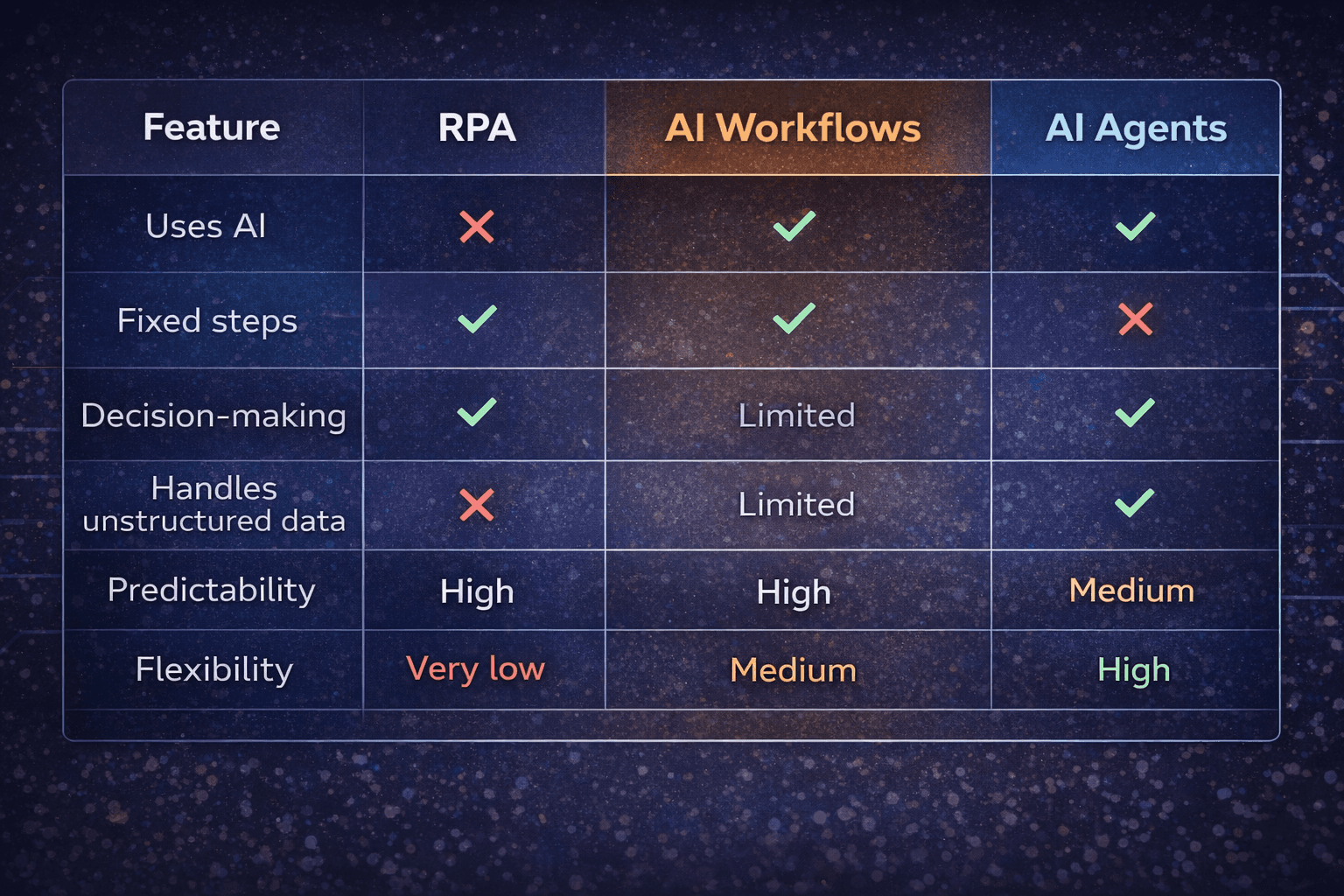
AI Workflows vs AI Agents vs RPA: Key Differences
Which Automation Approach Should You Choose?
There’s no universal answe, it depends on the problem.
Choose RPA if:
Your process is repetitive and stable, Data is perfectly structured
Choose AI workflows if:
You want intelligence with control, You need consistent outcomes
Choose AI agents if:
Your data is inconsistent or messy
Decisions depend on context
You want automation that adapts
In many real,world systems, the best solution is a hybrid approach combining all three.
A Practical Starting Point
Instead of starting with complex architecture, look at your team’s day,to,day work.
Ask yourself:
What tasks are painfully manual?
Where do workflows break because data isn’t clean?
Where do humans spend time making small decisions?
That’s often where AI agents or AI-powered workflows create the most value.
RPA, AI workflows, and AI agents aren’t competing ideas, they’re tools for different situations.
When used correctly, they help teams move faster, reduce manual effort, and scale operations without adding headcount.
The key is choosing the right level of intelligence for the problem you’re solving.
That’s how automation stops being fragile and starts becoming an advantage.