

AI Automations for Businesses With Messy Data
In this article, we’ll explain what messy data really means, why classic automation struggles, and how AI driven systems can help businesses automate despite the chaos.



AI Automations for Businesses With Messy Data
If your business data were clean, structured, and perfectly consistent, automation would be easy.
But that’s not reality for most teams.
Emails come in different formats. Spreadsheets don’t match. Customer notes live in half a dozen tools. Naming conventions change. Context gets lost.
This is what we call messy data, and it’s the biggest reason traditional automation fails.
The good news is that modern AI automations are designed specifically to work with messy data, not against it.
In this article, we’ll explain what messy data really means, why classic automation struggles, and how AI driven systems can help businesses automate despite the chaos.
Meta Description
Learn how AI automations help businesses handle messy, inconsistent data. Discover practical approaches using AI workflows and AI agents.
What Is Messy Data?
Messy data is any data that doesn’t follow strict rules.
It’s inconsistent, incomplete, unstructured, or constantly changing.
Common examples include:
Emails written in free text
PDFs with different layouts
CRM fields filled differently by each salesperson
Support tickets with missing information
Notes copied and pasted from multiple sources
Messy data isn’t a failure of your team, it’s a natural result of humans doing work.
Why Traditional Automation Breaks With Messy Data
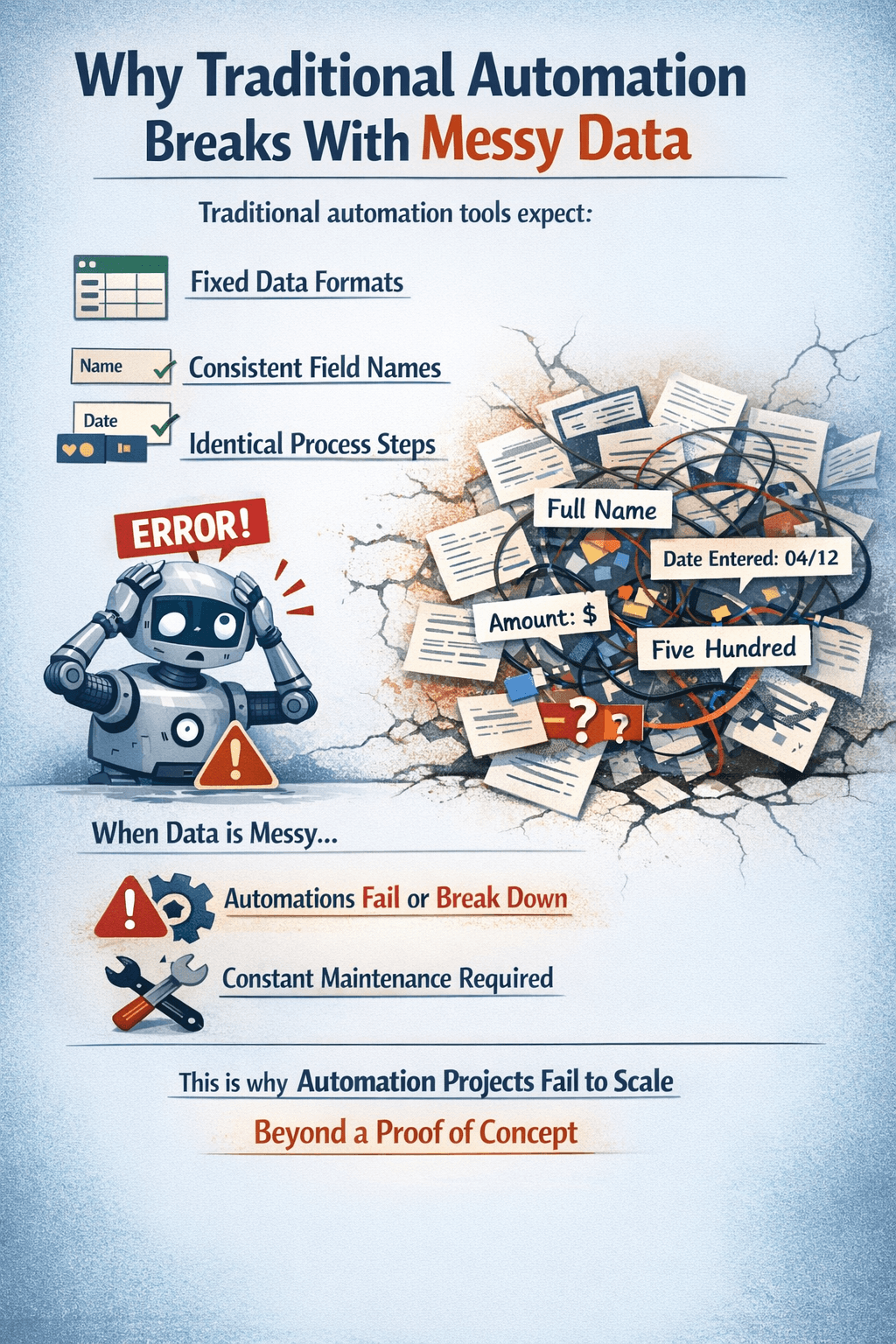
Traditional automation tools like rigid workflows or RPA depend on predictability.
They expect:
Fixed data formats
Consistent field names
Identical process steps
When data doesn’t match expectations, automations either fail silently or require constant maintenance.
This is why many automation projects never scale beyond a proof of concept.
How AI Automations Handle Messy Data Differently
AI automations don’t rely on exact matches or rigid rules.
Instead, they focus on understanding intent, context, and meaning.
Rather than asking, “Does this field exist?”, AI asks, “What is this trying to say?”
This shift makes automation far more resilient.
AI Workflows vs AI Agents for Messy Data
Not all AI automations are the same.
AI Workflows
AI workflows follow predefined steps but use AI inside those steps.
For example:
Classifying incoming emails
Extracting data from varied documents
Normalizing inconsistent fields
They work well when the process is known, but the inputs vary.
AI Agents
AI agents go a step further.
Instead of following a fixed path, they decide which steps to take based on the situation.
An AI agent can:
Read unstructured input
Decide what information is missing
Look it up in other systems
Ask follow up questions
Take action or escalate
This makes AI agents especially powerful for messy, real world data.
Real World Examples of AI Automations With Messy Data
Customer Support
AI agents can read free text emails, understand intent, pull relevant customer history, and draft responses even when the information is incomplete.
Sales Operations
AI workflows can clean CRM data, normalize lead sources, and enrich missing fields automatically.
Finance and Operations
AI systems can extract data from invoices and receipts with different formats and flag inconsistencies for review.
Reducing Risk With the Right System Design
Handling messy data doesn’t mean giving up control.
The most effective AI automations are built with:
Clear goals
Guardrails and validation steps
Human oversight where it matters
Fallbacks for low confidence situations
A well designed system minimizes inconsistency while keeping flexibility.
How to Get Started With AI Automation
Instead of trying to automate everything at once, start small.
Look for tasks where:
Humans constantly interpret messy information
Manual cleanup takes more time than decision making
Rigid workflows fail repeatedly
These are ideal candidates for AI powered automation.
Final Thoughts
Messy data isn’t a blocker to automation, it’s the reason AI automation exists.
When businesses stop forcing perfect structure and start using systems that can reason and adapt, automation becomes practical, scalable, and resilient.
AI automations don’t eliminate complexity.
They handle it for you.
That’s where real efficiency comes from.